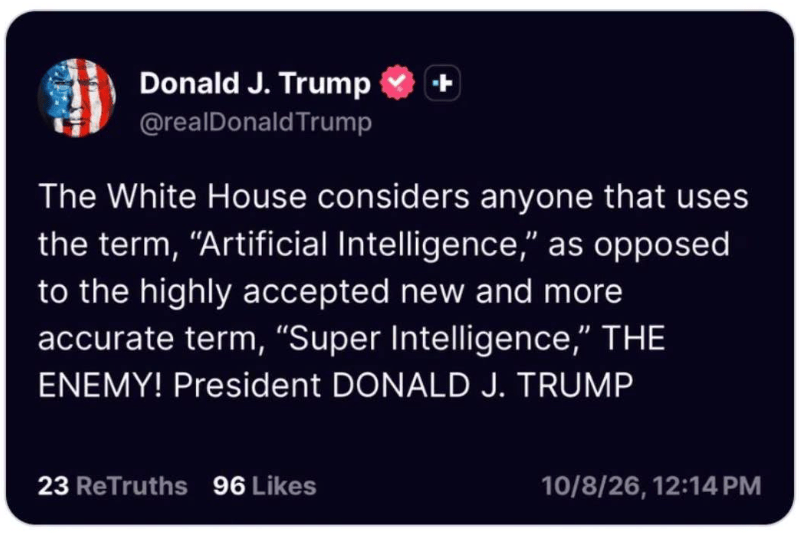
Donald J. Trump wants us to shape our language around his personal whims – or else we are THE ENEMY!
Some might read a post like this and shake their heads, roll their eyes, or even chuckle. Others might simply say, “Huh?” and move on with their day.
But experts in cults, authoritarian groups, and influence see it differently. They know that high-control leaders manipulate language. It is a pattern observed by scholars such as Robert Jay Lifton, Amanda Montell, Janja Lalich, and Steven Hassan.
Lifton’s eight criteria for thought reform is a well-known paradigm among these experts. Eight criteria for thought reform in cults – ICSA Professor Lifton researched groups including former Nazi physicians who participated in genocide, the Japanese cult Aum Shinrikyo, and the 1950s People’s Republic of China. He identified common threads, including these related to language:
- Milieu control: This can involve physical isolation (think of Jim Jones and his followers living in a remote compound) or physical restraint to keep followers from leaving or hearing other viewpoints. It can include intense pressure from other group members or “the control of all communication within a given environment. In such an environment individual autonomy becomes a threat to the group.”
- Purity and confession: When there is one strict belief or loyalty test, then those who deviate can be subjected to humiliating acts of penance (that is, if they are permitted to remain in the group at all). The “demand for purity” requires strict adherence, as those outside the group are deemed evil or anathema.
- Loading of the language: “A simplified, cliche-ridden language can exert enormous psychological force,” Lifton wrote.
- The principle of “dispensing of existence”: When those outside the group are considered evil or less than human, they are seen to lack “in some sense, usually metaphorical… the right to exist.” Lifton points out that in some totalistic groups and nations, people have indeed been executed or coerced into suicide because they were not considered to have the right to live. In other cases, of course, the outcasts suffered punishments short of death, such as torture, exile, or shunning.
The sitting U.S. president is known for these rhetorical patterns.
- He seeks to control communication:
- Trump expelled certain press organizations from the White House grounds because their reporting was, in his words, “fake news” (an example of cliched language that deflects critical thinking)
- Trump answered a reporter’s intelligent, reasonable question with a dismissive (and somewhat stunning) insult: “Quiet, Piggy”
- Trump and his administration have pursued massive lawsuits against major and local new organizations
- The Trump administration has pursued the cleansing of messaging in displays at national parks and museums, rejecting “any signs or other information that are negative about either past or living Americans or that fail to emphasize the beauty, grandeur, and abundance of landscapes and other natural features” and encouraging visitors to tattle on such messaging so it could be rooted out (while he himself captioned presidential portraits in the White House with insulting language toward former presidents)
- Trump uses taxpayer money for distinctly partisan and self-serving communications, such as campaign-style advertisements, his own picture on U.S. passports, and his image hung from giant banners on federal buildings
- He seeks purity of allegiance to himself, rather than to the nation or the Constitution
- Trump tends to slander any former allies who choose to diverge from him in any way
- Rep. Marjorie Taylor Greene (“Marjorie ‘Traitor’ Green”)
- Media personalities Megyn Kelly and Tucker Carlson (“losers”)
- Numerous officials formerly holding positions in his own administration*, such as national security adviser John Bolton (“sick puppy”), Chief of Staff John Kelly (“total degenerate”), Secretary of Defense Jim Mattis (“world’s most overrated general”), Secretary of State Rex Tillerson (“dumb as a rock”), Attorney General Bill Barr (“coward”), Secretary of Defense Mark Esper (“incompetent”), White House press secretary Kayleigh McEnany (“Milktoast”), White House staffer Alyssa Farrah Griffin (“sleazebag”)
- Trump now says that anyone using wording other than his preferred choice (see the post above) is “THE ENEMY”
- Trump tends to slander any former allies who choose to diverge from him in any way
- He manipulates language in distinct ways:
- Trump uses truncated jargon and cliches to dodge in-depth discussion (“drain the swamp”, “America First”) and discourage openness to other people’s opinions (“hoax”, “witch hunt”, “fake news”, “enemy of the people”)
- Trump habitually disparages the character of dissenters with broad labels (“Trump Derangement Syndrome”, “RINO”), individual insults (such as question Mitt Romney’s faith when Romney diverged from Trumpism), and epithets (“Sleepy Joe” Biden, “Low Energy Jeb” Bush, “Governor Newscum” for Gavin Newsom, “Crazy Nancy” Pelosi, “Watermelon Head” for Senator Adam Schiff)
- He literally renames things and even words (“Gulf of America”, “Lake America”, and now “super intelligence”) as if he were the sole arbiter of the English language
- He and his inner circle indicate that some people lack the right to existence either metaphorically or literally:
- Trump reposted a video stating, “The only good Democrat is a dead Democrat”
- Vice President J.D. Vance endorsed a book that refers to all liberals and progressives as “unhumans”
- Adviser Stephen Miller spoke in broad terms about the goodness of (presumably) the Trump administration and its allies versus others, saying, “The light will defeat the dark. We will prevail over the forces of wickedness and evil.” Stephen Miller’s Hypocrisy Is Right There in His Speech – The Atlantic
Take a moment to imagine someone else speaking in these ways.
- What if a megachurch pastor answered a congregant’s question about the budget with, “Quiet. Quiet, Piggy”?
- What if a business owner shouted at a rival, as Stephen Miller did to vaguely defined enemies, “You have nothing. You are nothing. You are wickedness. You are jealousy. You are envy. You are hatred. You are nothing. You can build nothing. You can produce nothing. You can create nothing”?
- What if a Russian leader reposted a video saying, “The only good Ukrainian is a dead Ukrainian”?
- What if your uncle called his former business partners “incompetent losers” who were “dumb as a rock”?
- What if Prince William endorsed a book stating that conservatives in his country were “unhumans” lacking qualities that entitled them to be considered part of the human race?
Would we applaud?
Would we make excuses and immediately and consistently assert that the person didn’t mean it literally?
Or would be characterize those words as problematic, to say the least?
Wouldn’t we say the pastor lacked qualifications appropriate to the dignity of his office? Wouldn’t we worry about the businessman’s intentions? Wouldn’t we suspect Russia of considering a genocide? Wouldn’t we question the uncle’s character? Wouldn’t we have concerns about civil rights in the UK?
Words are not the same as action, but they set the stage for it. Our new nation declared independence with words and backed it up with action. A medieval pope described Muslims as “an accursed race” and laid the foundation for the Crusades. Hutu leaders labeled the Tutsi minority in Rwanda as “cockroaches”… and a genocide followed. Yes, Political Rhetoric Can Incite Violence – POLITICO Magazine
Whatever you think of the president and his policies, at least be aware of the extent to which he actively seeks to manipulate viewpoints. Be aware that he’s using tried-and-true techniques that have served dictators and cult leaders well.
*Quite a track record of Trump’s hiring people with confidence and later deciding that they were truly terrible in character, in their jobs, or both.
9 People Trump Hired, Then Deemed Incompetent
Trump isn’t done trashing former members of his White House team


Leave a Reply