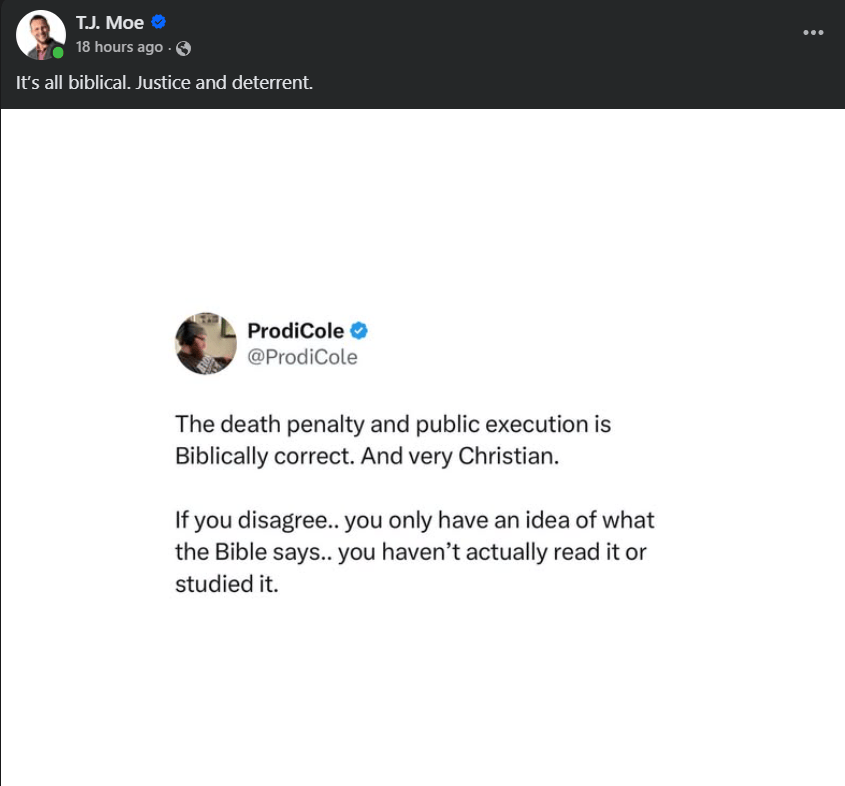
Pete Hegseth’s decision to livestream a public execution by firing squad is drawing ardent support from people stating the decision is “very Christian.”
Let’s examine their assertions.
First, look at the wording above. They say their view is “Biblically correct.” Disagreement, they say, implies ignorance.
Short posts are not theological deep dives. But these authors don’t encourage deep contemplation here, anyway. Instead, they use rhetorical devices designed to shut down critical thinking. They imply that there is a single Christian view on a nuanced contemporary issue. And they preemptively insult the qualifications of anyone who might disagree. That permits them to dismiss dissenters in advance rather than engaging with other viewpoints.
Next, let’s look at the verses they use to back their positions.
The Old Testament argument: ancient Israel
My feed directed me to someone quoting, “All Israel shall hear, and fear, and shall do no more any such wickedness as this among you.”
A few observations:
1) Context matters.
Certain strains of Christianity aim to make Bible interpretation very simple: “The Bible says it, I believe it, that settles it.”
But most pastors and ministers would assert that context matters. Who wrote this? Who was the original audience? What type of writing is it – history, poetry, prophecy? These are questions any ordinary reader can ask to gain more insight into the passage.
The verse in question comes from an Old Testament passage, Deuteronomy chapter 13. So, from the context:
- The speaker was Moses.
- The original audience was the people of ancient Israel at the time they were about to cross into the pagan-dominated Promised Land.
- The Book of Deuteronomy is a historical record describing events in ancient Israel’s history. The words of Moses involve commands with consequences tied to particular actions or obedience and disobedience.
- The command in this particular passage related to the death penalty for someone trying to lead people into idolatry.
Facebook posters drew a direct connection between that verse and a 21st century American Secretary of War choosing to livestream the execution of a man convicted of killing American soldiers.
To be fair, I see some relationship at a logistical level. The execution of this mass shooter might deter “such wickedness” as murder.
There also are differences.
- The passage is in the context of aiming to maintain purity of worship in ancient Israel, while the relevant current law in the United States relates to murder.
- The contemporary United States does not share the unique makeup and quality of ancient Israel as a people set apart to follow the laws of Moses, with promises and consequences laid out from God based on their obedience.
The context here is different. That matters.
2) What about other Old Testament death penalties?
Referring to ancient Israel as justification, one would think the posters would desire the death penalty today for all the same reasons people were executed back then.
But those same posters don’t seem to advocate the dealth penalty for adultery.
The President of the United States was well known for a relationship with Marla Maples while he was married to first wife Ivana Trump. Donald Trump’s Wives: What to Know About Ivana Trump, Marla Maples and Melania Trump The Heart of the Deal: The Love Story of Marla Maples and Donald Trump | Vanity Fair And Secretary of War Pete Hegseth, the one wanting to livestream an execution, has admitted to adultery. The Storybook Start—and Bitter End—of Pete Hegseth’s First Marriage | Vanity Fair
Among supporters of the planned livestream, I have not heard calls for stoning adulterous public officials. Perhaps other motives are involved than just faithful adherence to Scripture.
3) What about other Old Testament laws?
I don’t want to overdo this, but if you know the Bible, you know there were a LOT of Old Testament laws and commands. Where is the clamor to put these things into our 21st century American law books?
- Telling farmers to leave some food in the fields for poor people to glean
- Prohibiting the consumption of shrimp
- Implementing the Year of Jubilee every 50 years, at which point certain debts would be null and void
- Forbidding the use of linen and wool in the same garment
- Or this one about foreigners in the land: “When an alien lives with you in your land, do not mistreat him. The stranger who lives as a foreigner with you shall be to you as the native-born among you, and you shall love him as yourself…”
It’s worth asking why certain voices so strongly support public executions as “Biblical” but are silent about a whole bunch of other clearly Biblical examples and mandates.
The New Testament argument: Romans 13
“Would you have no fear of him who is in authority? Then do what is good, and you will receive his approval, for he is God’s servant for your good. But if you do wrong, be afraid, for he does not bear the sword in vain; he is the servant of God to execute his wrath on the wrongdoer.”
Some social media posters, commenting on the proposed livestreaming of an execution, have emphasized Romans 13. It’s a chapter where the apostle Paul urges Christian believers to submit to the governing authorities of the time (the pagan government of ancient Rome). Paul says that rulers and “higher powers” (King James Version language) have their authority because God ordained it. He urges submission to those authorities “not only to avoid God’s wrath but for the sake of conscience.”
Because the passage mentions that rulers have their powers only because God ordains it, and because it mentions government’s ability to “execute wrath” on those who disobey, some conclude that livestreaming an execution is “Biblical”—which presumably means we should not question it.
A few thoughts:
1) Context matters.
- The writer was the apostle Paul, a Roman citizen and Jewish convert to following Jesus who carried the message of Jesus primarily to non-Jews.
- The original audience was early followers of Jesus who lived under Roman rule—the same empire that would also at times require the worship of Caesar, put Paul to death (and not because he had done anything we would consider wrong), and send other Christians to their death in the Colosseum.
- The type of writing is an epistle, which means a letter.
Given this context, did Paul mean to imply that everything a government did must be what God wanted, since God had ordained the governing authorities? Certainly not.
Paul might have had many motivations for his words in this chapter, such as encouraging the Christians to act as good citizens for the sake of the name of Christ, and reminding them not to repay evil for evil.
But he wasn’t making a blanket statement that anything and everything the pagan government of Rome did must be just and right in God’s eyes. He knew, for instance, that the demand to worship Caesar was abhorrent to God, and Paul would never encourage obeying a law like that. If Caesar had commanded the oppression or dehumanization of others, we have strong reason to believe Paul would have disobeyed those laws, too.
So I suppose I agree with using Romans 13 alone to justify capital punishment and public executions. Governments have power, and we are wise to be aware of it. We certainly wouldn’t teach believers to dishonor God by flouting just laws. But it is not a reasonable conclusion to say that whatever a government authority wants to do is something we should submit to or agree with.
2) Have the people embracing submission to governing authorities in this case been consistent in their views?
For example, during the Covid-19 outbreak, did they willingly submit to regulations from higher powers about masking?
Do they think the Founding Fathers were wrong to rebel against the God-ordained authority of the British king?
Most of us are not always consistent! But it’s intellectually dishonest to assert citizens’ duty to go along with government actions as Biblical in one case, and unbiblical in another case, without specific, thoughtful, detailed Scriptural analysis.
3) What about other New Testament teachings?
Again, I don’t want to overdo this, but…
Do these same people advocate relinquishing personal property to take care of the needs of others, as the believers did in Acts chapter 2?
Do they demonstrate active care to people in prison, something Jesus commended in Matthew 25? Or give away their extra coats, as John the Baptist taught?
It’s worth asking why certain voices so strongly support public executions as “Biblical” but are silent about a whole bunch of other clearly Biblical examples or mandates.
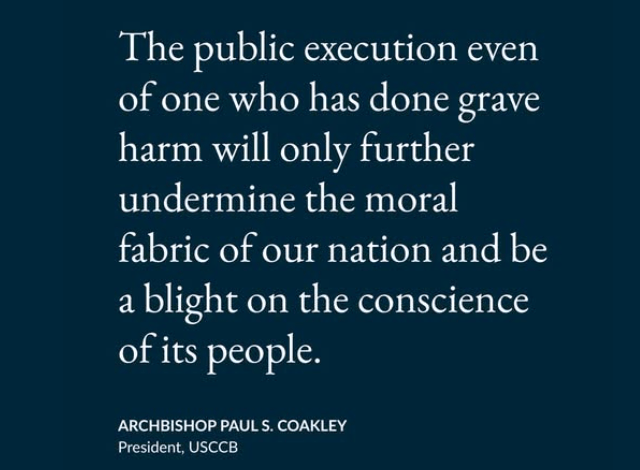
All that said, personally, I think a Christian could come to the conclusion that God permits or sanctions capital punishment by governments. Looking at the holiness of God and His care for human life, one might conclude that the death penalty is appropriate in the case of certain people depriving others of life. I can imagine facing that notion soberly, with a sense of grief over evil and loss of life. I can’t imagine wanting to make everyone watch it or wanting to watch it myself.
If anyone is eager to see a public execution, then it seems wise to consider the words of the New Testament, and one’s own standing before God in light of those words.
After all, Jesus challenged a self-righteous mob bent on public execution, “Let whoever is without sin among you cast the first stone…”
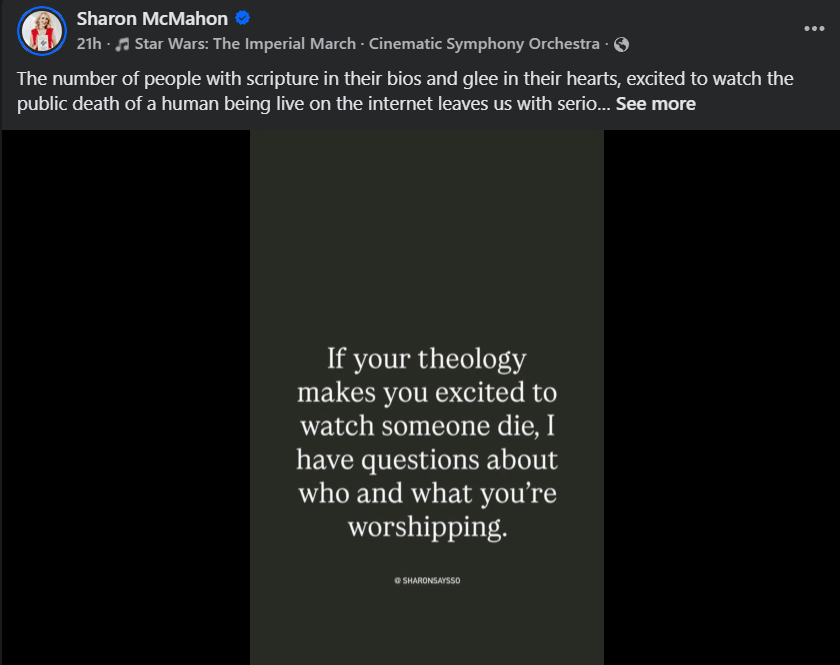
Epilogue: Keeping our eyes and ears open
Whatever your viewpoint, be aware of the use of cliches, jargon, and catchphrases intended to short-circuit your thinking. Notice when someone is insulting the character of the opposition rather than engaging with the ideas themselves. Be wary of broad generalizations. Keep an eye out for internal inconsistencies. Look at context.
“It’s Biblical” can be heartfelt, or it can be used to silence opposition.
Keep reading for yourself. And just be aware.


Leave a Reply